• Fritsch GmbH Mahlen und Messen | Probenaufbereitung und Partikelmessung

    • Products
    • Solutions
    • Encyclopedia
    • Service
    • News
    • About us
    • Contact
    • Home
    • Contact
    • Print
    • erp
    • English USA
    • English UK
    • Deutsch
    • French
    • Russian
    • IT
    • ES
    • Chinese
    • Japanese
    • Particle Sizing
    • ·
    • Solutions
    • ·
    • Dispersion
      • Sample preparation
      • Dispersion
      • Difficult samples
      • Application examples
      • Sizing reports

      Particle Sizers

      FRITSCH Product Manager Particle Sizers
      Dr. Günther Crolly

      Phone: 0049 67 84 70 138

      Mobile: 0049 151 14 27 27 14

      crolly(at)fritsch.de

    • Dispersion

      Many samples - due to their material characteristics - require a special preparation for the measurement. For example can static charges (for example plastics), adhesion forces or cohesive forces (for example clays, soil samples, kaolins), magnetism and hydrophobic characteristics (for example pharmaceutical products, drugs, toner, graphite, titanium oxide) or coagulation (for example clays, kaolins, chalk and gypsum), complicate the dispersion and measurement.


      When dispersion is necessary in order to measure the primary particles, generally two different dispersions are possible: the wet dispersion and dry dispersion.
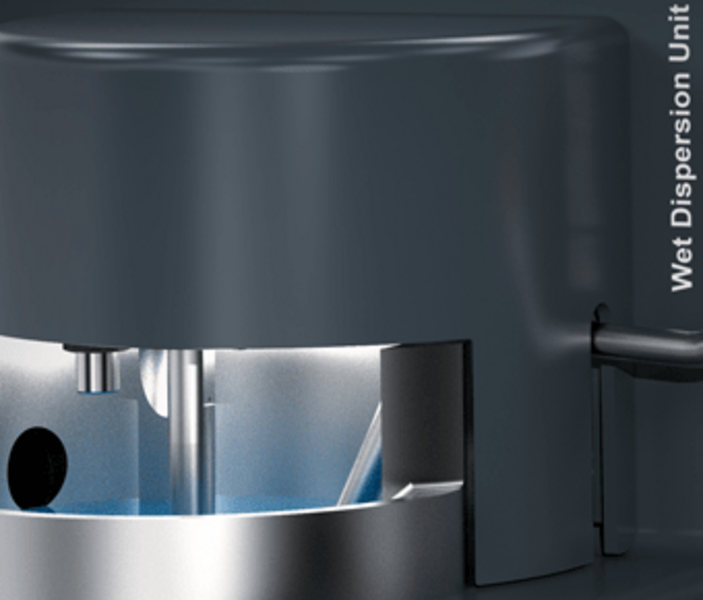
      During a wet-dispersion the sample material is added to a closed liquid circuit and continuously pumped through the measurement cell. During the pumping process in the measuring circuit, ultrasound can be added in order to break up the agglomerates and obtaining single and separated particles. Unproblematic samples that submerse directly in water without significant effort and do not have large fines, are added to the dispersing unit of the ANALYSETTE 22 as a solid, portion by portion, using a spatula and can be measured reproducibly after a brief ultrasound exposure / dispersion (30 - 60 s).

      Prior to a measurement, especially for strongly bonded agglomerates, a treatment of the sample, with ultrasound with the LABORETTE 17 is often helpful. For the wet dispersion, if possible should the selected liquid wet the material spontaneously and completely. Certain materials cannot be measured in liquids at all or with great difficulty, because these dissolve, a chemical reaction occurs or they swell – like for example wheat. In these cases a dry dispersion is an alternative.
      With a high-frequency feeder the sample material is continuously transported over the funnel-shaped opening of the dry measuring cell and then drops in the actual dispersion area. In an annular gap Venturi nozzle the powder is accelerated and passes with high speed through the nozzle channel and the measurement of the particle size distribution in the laser beam takes place directly behind it. Then it passes a zone with aerodynamic wave generation at the nozzle outlet. The by the high turbulent current caused strong shearing forces, as well as blows between the particles, lead to the breakdown of the agglomerates. No impact areas in the flight path of the particles exist in order to prevent soft sample materials from being ground during the dispersion process.


      Instrument-Recommendation:
      ANALYSETTE 22 MicroTec plus or NanoTec plus


      Perfect for the quick production of heterogeneous wet dispersions:
      FRITSCH-Ultrasonic Cleaners LABORETTE 17


      Additional information about these samples in Difficult Samples

      FRITSCH-Know-How – For an exact measurement should:


      • The solids are separated and free of agglomerates.


      • During the entire measurement the dispersion condition should be stable, without coagulation or flocculation.


      • Floating particles on the liquids surface should be avoided.


      • The sample should not be destroyed respectively comminuted during the dispersion.


      • Ideally, the carrier liquid should have a lower weight (density) than the solid.

    • Direct links
    • Login
    • Contact
    • Purchase & Payment Terms
    • Imprint
    • Recommend page
    • Print
    • Sample Preparation
    • Particle Sizing
      • Service / Solutions


        Service

        Application Consultation

        Technical Support

        Maintenance Module

        Free-of-charge Sample Analysis

        Downloads

        Online guarantee

        QA certificates


        Solutions

        Sample preparation

        Dispersion

        Difficult samples

        Application examples

        Particle Sizing reports

        Encyclopedia

        Particle Measurement


      • Products for Particle Sizing


        Laser diffraction

        Measuring range 0.08 – 2000 µm

        Measuring unit

        Wet dispersion

        Dry dispersion

        Falling chute

        Small volume wet dispersion

        Software


        Measuring range 0.01 – 2000 µm

        Measuring unit

        Wet dispersion

        Dry dispersion

        Falling chute

        Small volume wet dispersion

        Software


        Dynamic light scattering DLS:

        Measuring range 1 nm – 6 µm

      • Contact / News


        Contact

        Application Consultation

        Technical Support

        Maintenance Module

        Contact worldwide


        News

        News

        Roadshows

        Workshops

        Fairs

      • Links


        Further domains

        www.fritsch-sizing.de

        www.fritsch-sizing.fr

        www.fritsch-sizing.ru

        www.fritsch-sizing.es

        www.fritsch-sizing.it

        www.fritsch-sizing.com.sg

        www.fritsch-sizing.cn

        www.fritsch-sizing.jp

        www.fritsch-sizing.co.kr


        www.fritsch-milling.com

      • For registered users

        Enter your email address and password:

        Forgot your password?

      • Please complete the form below for your account: